Friedrich Nietzsche
Free The Antichrist Nietzsche PDF: Download Nietzsche's The Antichrist Free PDF & EPUB
Why readers search for a free The Antichrist Nietzsche PDF
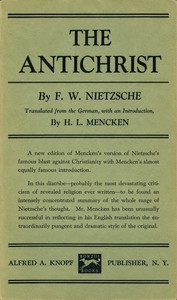
If you are looking for a free The Antichrist Nietzsche pdf, you are looking for the most provocative book Friedrich Nietzsche ever wrote. The Antichrist, written in 1888 and first published in 1895, is Nietzsche's fierce attack on Christianity, and it remains one of the most quoted and most argued-over books in philosophy. Readers search for a The Antichrist free pdf download because the book's title is famous, its sentences are unforgettable, and its argument is unlike anything else in philosophy. Philosophy students read it for courses on Nietzsche, religion, and modern thought, and general readers read it because they want to know what the philosopher who declared that God is dead actually said. Because Nietzsche died in 1900, the book is in the public domain in the United States, so you can download it legally and free, with no account and no payment.
What The Antichrist is about
The Antichrist is a short, furious polemic, and Nietzsche wastes no time on polite introductions. He calls Christianity a conspiracy against life, strength, and joy, a religion that, in his view, teaches people to despise the body, the instincts, and this world, and to hope instead for another world that does not exist. He contrasts the good news of Jesus himself, whom he treats with a strange respect, with the church that followed him, which he says turned a simple message of love into a system of guilt, priestly power, and moral condemnation. Nietzsche praises the ancient world that Christianity displaced, the Greeks and Romans, with their love of beauty, strength, and the present moment, and he argues that Europe declined when it abandoned those values. The book is written in short, hammering paragraphs, full of insults, paradoxes, and brilliant phrases, and it builds to a final section that denounces Christianity in the strongest language Nietzsche ever used.
The ideas at the heart of The Antichrist
The central idea of The Antichrist is Nietzsche's claim that what a religion calls good reveals what kind of life it serves. A religion that praises weakness, humility, and suffering, he argues, is a religion made by people who cannot affirm life as it is, and it spreads by teaching healthy people to feel guilty about their strength. Nietzsche calls pity a dangerous virtue, because it preserves what is weak at the expense of what could grow strong. He attacks the Christian idea of sin, arguing that guilt is a sickness invented by priests to keep power over people. He also attacks the idea of a soul separate from the body, and the idea of a heaven that rewards obedience after death, both of which, he says, turn people away from the only life they have. Against all of this he sets his own ideal: the strong, joyful person who says yes to life, to the body, and to the earth, and who creates values instead of receiving them from a church. Readers who know Beyond Good and Evil will recognise the same ideas here, the will to power and the revaluation of all values, pushed to their most extreme and most personal form.
About Friedrich Nietzsche
Friedrich Nietzsche was born in Germany in 1844, the son of a Lutheran pastor, and he became a professor of classical philology at the University of Basel at the age of twenty-four. Ill health forced him to resign in 1879, and he spent the next decade travelling through Switzerland, Italy, and France, writing the books that made him famous. The Antichrist was written in 1888, in the last productive year of his life, alongside his final works. His health collapsed in early 1889, and he spent his remaining years in mental illness, dying in 1900. The English translation in this edition was made by the American critic H. L. Mencken in 1920, and Mencken's lively, forceful English helped make Nietzsche famous in America. Nietzsche's best-known book, Thus Spoke Zarathustra, had appeared a few years earlier, and Beyond Good and Evil had set out his philosophy in systematic form; The Antichrist is the most passionate application of that philosophy to religion.
The history of The Antichrist
The Antichrist was written in 1888 but was not published until 1895, several years after Nietzsche's collapse, because its attack on Christianity was considered too shocking to print at once, and even the first published edition left out some passages. When it finally appeared, it confirmed Nietzsche's reputation as the most dangerous thinker in Europe. In the twentieth century, the book was read by existentialists, psychologists, and literary critics, and its phrases entered everyday language. The H. L. Mencken translation of 1920 brought it to American readers in vigorous English, and it has stayed in print ever since. Today the book is a standard text in courses on philosophy of religion and modern thought, and the Nietzsche Antichrist summary is a common student search, because readers want help with a book that is short but dense with provocation. Its influence reaches far beyond philosophy: writers, artists, and theologians still argue with it, and many readers say it changed how they think about religion even when they disagree with it.
Why readers still read The Antichrist today
Readers still read The Antichrist because it is short, direct, and impossible to ignore. At under two hundred pages in most editions, it can be finished in an evening, yet it contains some of the most famous sentences Nietzsche ever wrote. Students read it to understand the critique of religion, the idea of the will to power, and the origins of existentialism. General readers read it because it forces them to ask hard questions: what do I actually believe, and why, and what would I believe if I thought for myself? Even readers who are Christians often find the book valuable, because Nietzsche's attack is aimed less at ordinary believers than at the institutions and ideas that, in his view, betray the message of Jesus. The book rewards reading alongside Beyond Good and Evil, which explains the philosophy behind the polemic, and Thus Spoke Zarathustra, which offers Nietzsche's poetic alternative.
How to download The Antichrist free in PDF and EPUB
You can download The Antichrist free on Noveliopdf in both PDF and EPUB formats. Visit the book page, choose the format that suits your device, and the file downloads while the website stays open, with no sign-up and no payment. The PDF is ideal for reading on a computer or tablet and for printing pages for class, while the EPUB works on phones, e-readers, and apps such as Apple Books, Google Play Books, and the Kindle app. Kindle owners can send the EPUB to their device with the Send to Kindle service. Because the book is in the public domain, the download is completely legal in the United States. After this book, continue with Nietzsche's Beyond Good and Evil and Thus Spoke Zarathustra, or compare his attack on religion with the very different philosophy of John Stuart Mill in Utilitarianism.