George Bernard Shaw
Free Saint Joan by George Bernard Shaw — PDF EPUB Download
Free Saint Joan PDF: Shaw's Great Play of Joan of Arc
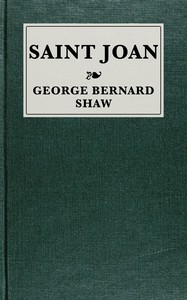
If you are looking for a free Saint Joan pdf, you have found George Bernard Shaw's greatest play. First performed in New York in December 1923 and published in 1924, Saint Joan tells the story of Joan of Arc, the peasant girl who heard the voices of saints, led France to victory, and was burned as a heretic by the very church she served. Shaw called it a chronicle play in six scenes and an epilogue, and it is a profound drama of faith, power, and the loneliness of genius. The play is in the public domain in the United States, which means you can download it legally and free in PDF and EPUB on Noveliopdf, with no account, no payment, and no trial to cancel. Whether you are studying drama, reading about Joan of Arc, or discovering Shaw for the first time, this free Saint Joan pdf is the play to read.
Joan of Arc was born about 1412 in the village of Domrémy, in the Vosges, the daughter of a peasant farmer. In 1429, at the age of seventeen, she went to the Dauphin, the future Charles VII of France, and told him that God had sent her to save France from the English, who had occupied much of the country. She was given command of troops, she raised the siege of Orléans, and she saw the Dauphin crowned at Reims. Then, in 1430, she was captured by the Burgundians, who were allied with the English, and sold to the English, who put her on trial for heresy at Rouen. The trial was a political act disguised as a religious one: the English needed to discredit the king she had crowned, and the churchmen who tried her needed to prove that her voices were not from God. Joan was condemned and burned at the stake on 30 May 1431, at the age of nineteen. Twenty-five years later, in 1456, the church overturned the verdict, and in 1920, nearly five hundred years after her death, Pope Benedict XV proclaimed her a saint. Shaw's play follows this whole story, from Joan's first meeting with the Dauphin to her trial and her burning, and then, in a famous epilogue set twenty-five years later, he brings her back in a dream, to meet the men who condemned her and to hear that she will one day be canonised. The epilogue ends with Joan's great question, still unanswered: "O God that madest this beautiful earth, when will it be ready to receive Thy saints? How long, O Lord, how long?"
What Saint Joan Is About
At its heart, Saint Joan is a play about what happens to a person who is too far ahead of their time. Shaw believed that Joan was not a mystic or a madwoman, but a practical genius, a girl of extraordinary common sense and courage who understood things that the clever men around her could not understand. She understood that France needed a nation, not a collection of feudal lords, and that an army needed discipline and morale, not just noble birth. She understood, too, that the church and the state of her day could not tolerate someone who claimed to hear God directly, because such a claim threatened their authority. Shaw's great insight is that the people who condemned Joan were not villains. The English nobles, the churchmen, and the Inquisitor all acted according to what they thought was right, and Shaw shows them as intelligent, honest men who were trapped by the institutions they served. The tragedy is not that bad men killed a good woman, but that good men, serving a system that could not change, killed the one person who could see beyond it. The play is also a brilliant piece of theatre. Shaw gives Joan a voice that is at once simple and commanding, and he fills the play with scenes of great power: Joan's first audience with the Dauphin, her triumph at Orléans, her trial, and her final walk to the stake. The trial scene, in which Joan defends herself against learned churchmen with nothing but her own clear mind, is one of the greatest scenes in modern drama.
Why Saint Joan Still Matters
Saint Joan still matters because it is one of the great plays about conscience, power, and the cost of being right. Shaw wrote it after the First World War, when the world had seen what happens when nations and churches and institutions demand obedience, and he wrote it as a warning and as a tribute. The play helped to make Shaw's reputation, and it is the work most closely tied to the Nobel Prize in Literature that he received in 1925. It is also one of the most performed of all Shaw's plays, and the role of Joan has been played by many of the greatest actresses of the twentieth century, from Winifred Lenihan, who created the part in New York in 1923, to Sybil Thorndike, who played it in London in 1924. Modern readers will find the play strikingly relevant. Joan's story is the story of every person who has stood up to power and paid the price, and Shaw's treatment of her trial raises questions that are still being asked today: who has the right to judge conscience? When does loyalty to an institution become a crime? And how long does it take for the world to recognise its saints? The play's long preface, in which Shaw sets out his view of Joan and of history, is itself a masterpiece of prose, and it is included in the free edition. Readers who enjoy Pygmalion, Shaw's most famous comedy, will find here a very different Shaw, serious, passionate, and at the height of his powers.
About George Bernard Shaw
George Bernard Shaw (1856-1950) was born in Dublin, the son of a corn merchant, and he came to London in 1876, where he became a music critic, a socialist, and a playwright. His early plays, including Arms and the Man, Candida, and Man and Superman, made him famous for his wit and his willingness to attack every received opinion. Major Barbara and Pygmalion, the play that became the musical My Fair Lady, are among his best-known works. Shaw was a vegetarian, a socialist, and a tireless controversialist, and he wrote about everything from religion to spelling reform. Saint Joan, written in 1923, was his masterpiece, and it won him the Nobel Prize in Literature in 1925. He lived to be ninety-four, and he wrote plays until the end of his life, always with the same belief: that drama should be a forum for ideas, and that the theatre could change the world. He remains one of the greatest playwrights in the English language, and Saint Joan is the play in which his genius found its fullest expression.
How to Download Saint Joan Free in PDF and EPUB on Noveliopdf
Downloading your free Saint Joan pdf or EPUB could not be simpler. Open the book page for Saint Joan on Noveliopdf and choose the format you want. The PDF is ideal for reading on a computer or tablet, or for printing, while the EPUB works beautifully on e-readers and reading apps on your phone. Both files are free, legal, and complete, with no sign-up and no cost, because the play is in the public domain. If you are new to Shaw, you might begin with Pygmalion, his most famous comedy, or Arms and the Man, his witty attack on romantic ideas of war, and then come to Saint Joan for the full force of his genius. Download it free today and meet Joan of Arc, the saint who was burned for hearing voices, in the play that made her immortal.