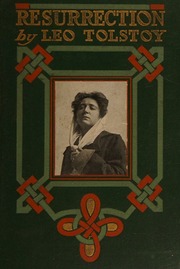
Leo Tolstoy
Free Resurrection PDF EPUB Download by Leo Tolstoy
If you are looking for a free Resurrection pdf, you have found Leo Tolstoy's final novel, a story of guilt, forgiveness and second chances that many readers consider his most moving book. Resurrection by Leo Tolstoy, first published in 1899, follows a rich nobleman who recognises the woman on trial before him as the servant girl he seduced and abandoned years earlier, and who gives up everything to follow her into exile and earn her forgiveness. Because Tolstoy died in 1910, the novel is in the public domain in the United States, and you can download it legally and free from Noveliopdf in both PDF and EPUB, with no account and no payment.
This guide explains the story of the novel, the life of the man who wrote it, the remarkable history behind its publication, and why readers still turn to it when they want a novel about conscience. It also shows you how to get your Resurrection free pdf download on Noveliopdf in minutes.
What Resurrection Is About
Prince Dmitri Nekhlyudov is a wealthy young nobleman serving as a juror in a Moscow court when the accused is brought in: a prostitute charged with poisoning a client. He recognises her at once. She is Maslova, known to him as Katyusha, the young servant girl in his aunts' house whom he seduced one Easter night years before and then abandoned with a hundred-rouble note. She became pregnant, lost the child, was thrown out of the house, and slid step by step into the life that has brought her to this courtroom. Nekhlyudov is struck with guilt so suddenly and so completely that it remakes his life. He discovers that the jury has convicted her by mistake, through a careless error, and that she has been sentenced to four years of hard labour in Siberia.
What follows is Nekhlyudov's long attempt at atonement. He visits Maslova in prison, begs her forgiveness, and offers to marry her. She refuses him at first, bitterly and rightly, and he refuses to give up. He hires lawyers, petitions the authorities, and follows the convoy of prisoners on their terrible march toward Siberia, watching how the system grinds ordinary people down. Along the way Tolstoy turns his gaze on everything Nekhlyudov's world is built on: the courts that condemn people they do not understand, the prisons that punish the poor and spare the rich, the churches that bless the whole arrangement, and the landowners who live off peasants they never meet. Nekhlyudov gives away his land to the peasants, breaks with his old life, and slowly becomes a different man, while Maslova, who has found a new dignity and purpose among the political prisoners, must decide whether she can ever forgive the man who ruined her.
The title has a double meaning. Nekhlyudov is resurrected from his dead, selfish life into a moral one, and Maslova is resurrected from shame into a person who can choose her own future. It is a novel about the moment a person truly sees what they have done, and what that seeing costs.
About Leo Tolstoy
Leo Tolstoy was born in 1828 into an aristocratic family at Yasnaya Polyana, the country estate in central Russia where he would live most of his life. He served as an army officer in the Caucasus and in the Crimean War, then became the most famous novelist in the world with War and Peace, published in 1869, and Anna Karenina, published in 1878. Those two novels made him rich and celebrated, but they did not make him happy. In middle age he went through a deep spiritual crisis, questioning his wealth, his faith and the meaning of his life, and he emerged as a radical Christian thinker who preached non-violence, simple living and resistance to the state. He gave up hunting, meat and eventually the comforts of his own house, dressed like a peasant, worked in the fields beside his labourers, and wrote tracts condemning the church, the army and the courts. The Russian Orthodox Church excommunicated him in 1901, and he spent his last years in open conflict with his family over his fortune and his beliefs. He died in 1910 at a remote railway station, having fled his home at the age of eighty-two.
Resurrection is the novel of that later Tolstoy. It is less famous than his two great masterpieces, but it is the book in which he finally put his moral philosophy into a story, and it is written with the same unmatched eye for human nature.
The History of the Novel
Tolstoy worked on Resurrection for ten years, beginning in 1889, and the story grew out of a real case told to him by a friend, the lawyer Anatoly Koni, about a nobleman who recognised a prostitute on trial as a girl he had once seduced. When the novel was finally serialised in 1899, it was an international event: readers across Europe and America followed each instalment, and Tolstoy gave the large sums he earned to help a persecuted religious group, the Doukhobors, emigrate from Russia to Canada. The Russian edition was heavily cut by the censors, who removed his attacks on the church and the courts, so the full text first appeared abroad. The free edition on Noveliopdf uses the English translation by Louise Maude, published in 1900, made by the woman who, with her husband Aylmer Maude, knew Tolstoy personally and produced the translations he himself preferred.
Because it was Tolstoy's last novel, Resurrection has a special place in his work. War and Peace and Anna Karenina look at Russian society from the inside, with love and irony; Resurrection judges it. The courtroom scenes, the prison chapters and the Siberian march are based on Tolstoy's own visits to prisons and courts, and on conversations with convicts, and they read like journalism as much as fiction. That documentary anger is part of why the book still hits so hard.
Why Readers Still Read Resurrection Today
Readers keep returning to Resurrection because it asks the question most novels avoid: what do you do after you have done something unforgivable? Nekhlyudov cannot undo what happened to Maslova, and Tolstoy refuses to let him off the hook with a grand gesture. Forgiveness has to be earned slowly, through humiliation, patience and real sacrifice, and even then it is not guaranteed. That honesty is what makes the novel feel modern. It is also a great courtroom and prison novel, decades ahead of its time, and its indictment of a justice system that punishes poverty while protecting privilege still reads like today's news. Students read it alongside War and Peace and Anna Karenina to see the full arc of Tolstoy's genius, and ordinary readers love it because, for all its moral seriousness, it is a gripping story: a trial, a prison, a long journey across Russia, and a love that has to be rebuilt from nothing.
How to Download Resurrection Free (PDF and EPUB)
Getting your free Resurrection pdf is simple. Visit the book page for Resurrection by Leo Tolstoy on Noveliopdf and choose the format that suits you. The PDF is best for reading on a phone, tablet or computer, with fixed pages you can search and bookmark. The EPUB is best for e-readers and reading apps, and Kindle owners can send it straight to their device with Amazon's Send to Kindle service, which has accepted EPUB files since 2022. Both files are the complete novel, legally free in the United States because the book is in the public domain, and there is no sign-up, no trial and nothing to pay. Because Resurrection is a long novel, the EPUB is especially handy: it lets you change the font size and read comfortably on a small screen. When you finish, continue with Tolstoy's masterpieces War and Peace and Anna Karenina, and with Dostoevsky's Crime and Punishment, all free on Noveliopdf in PDF and EPUB.





