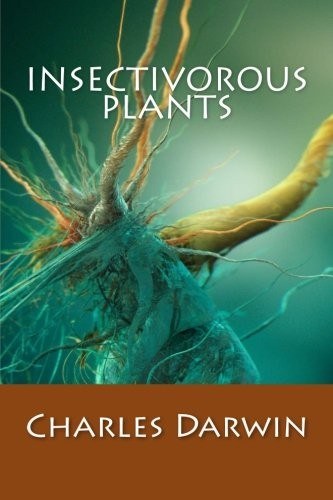
Charles Darwin
Free Insectivorous Plants by Charles Darwin — PDF EPUB Download
Free Insectivorous Plants PDF: Darwin and the Plants That Eat Animals
If you are looking for a free Insectivorous Plants Darwin pdf, you have found one of the strangest and most delightful books of Victorian science. Published in 1875, Insectivorous Plants is Charles Darwin's astonishing account of the sundew, the Venus flytrap, the bladderwort, and other plants that catch and digest insects. Through years of patient experiments with meat, milk, and salts of ammonia, Darwin showed that these plants sense, move, and digest almost like animals. It is a book full of wonder, and it is in the public domain in the United States, so you can download it legally and free in PDF and EPUB on Noveliopdf, with no account and no payment.
The story began in the summer of 1860, when Darwin was on holiday in Sussex and noticed the sundew, a small, sticky-leaved plant that grows in bogs, covered with tiny insects. He brought some plants home to Down House, and he began to experiment. He placed bits of meat, egg, milk, and cheese on the leaves, and he watched, hour by hour, as the tentacles of the plant bent slowly inward, wrapping themselves around the food. He tested the plant with drops of water, with sand, and with glass, and he found that it could tell the difference between something nourishing and something useless. A drop of milk would make the tentacles close. A grain of sand would not. Darwin was amazed. Here was a plant that could sense, that could move, and that could digest, and he spent the next fifteen years finding out how.
What Insectivorous Plants Is About
The book describes Darwin's experiments in loving detail. He worked first with the sundew, Drosera rotundifolia, and then with the Venus flytrap, Dionæa muscipula, whose hinged leaves snap shut on any insect that touches their trigger hairs twice within a few seconds. He studied the butterwort, whose sticky leaves trap flies, and the bladderwort, a rootless water plant whose tiny bladders suck in water fleas and other small creatures with a speed that Darwin could barely follow. He also studied the pitcher plants, whose deep cups fill with water and drown the insects that fall in. For each plant he asked the same questions: how does it sense its prey, how does it catch it, and how does it digest it?
Darwin's experiments were extraordinarily thorough. He fed the plants with measured amounts of meat, albumen, gelatin, and salts of ammonia, and he discovered that they were astonishingly sensitive. A sundew could detect a speck of ammonium carbonate weighing less than a millionth of a grain, a sensitivity that seemed almost impossible. He found that the plants secreted a digestive fluid very like the gastric juice of animals, and that they absorbed the nitrogen from their prey, a discovery that explained why insect-eating plants grow in poor, boggy soils where nitrogen is scarce. They eat insects, Darwin showed, because they cannot get enough nitrogen from the ground. It was a beautiful piece of reasoning, and it turned a botanical curiosity into a chapter of evolutionary theory.
Why the Book Matters to Evolution
Insectivorous Plants was not a mere catalogue of curiosities. It was a piece of evidence for evolution, and a particularly powerful one. If plants and animals were separately created, there would be no reason for a plant to behave like an animal. But if all living things are related by descent, then it is natural that a plant should have inherited some of the powers of animals, and should have developed them in its own way. Darwin showed that the sundew's tentacles bend like the fingers of a hand, that the flytrap's leaves close like a jaw, and that the digestive fluids of plants resemble the digestive fluids of animals. The book was a demonstration that the boundary between plants and animals is not a wall but a bridge, and that evolution can produce the same solutions in very different forms of life.
The book is also a wonderful portrait of how science is actually done. Darwin's laboratory was his greenhouse and his study, and his instruments were simple: a microscope, a pair of tweezers, a notebook, and endless patience. He repeated his experiments dozens of times, he recorded failures as carefully as successes, and he invited his friends and his sons to check his results. He was assisted by his son Francis, who would later become a distinguished botanist himself, and the book is full of their shared excitement at each new discovery. It is science as a human adventure, carried out by a father and son in a country garden.
About Charles Darwin
Charles Darwin (1809-1882) was an English naturalist whose theory of evolution by natural selection is one of the greatest achievements in the history of science. His books include On the Origin of Species, The Descent of Man, The Voyage of the Beagle, and The Autobiography of Charles Darwin, all free on Noveliopdf. His later work on earthworms, published as The Formation of Vegetable Mould, grew out of the same patient, garden-based method. He was buried in Westminster Abbey, beside Isaac Newton.
Why Insectivorous Plants Is Still a Joy to Read
Insectivorous Plants is one of the most readable of all Darwin's books, because its subject is so wonderfully strange. Who would have thought that a plant could hunt? Darwin's excitement is infectious, and his descriptions of the sundew closing on a fly, or the flytrap snapping shut, are as vivid as any scene in a novel. The book is also a reminder that great science does not need great equipment. Darwin changed our understanding of life with a few potted plants, a microscope, and fifteen years of patient watching. For gardeners, for nature lovers, for students of biology, and for anyone who likes a good story, it is a delight.
How to Download Insectivorous Plants Free in PDF and EPUB
Because Insectivorous Plants was published in 1875, it is in the public domain in the United States, and a free Insectivorous Plants Darwin pdf download from Noveliopdf is completely legal. You can read it on your phone, tablet, e-reader, or computer, in PDF or EPUB format, with no sign-up, no payment, and no limits. The EPUB version is ideal for e-readers and reading apps, while the PDF version keeps the layout fixed and is easy to read on a larger screen or to print.
If Darwin's botanical detective work fascinates you, Noveliopdf offers his other great works free in PDF and EPUB, including On the Origin of Species, The Formation of Vegetable Mould, and The Natural History of Selborne by Gilbert White, the classic of English nature writing that Darwin himself admired. Together they show the patient, observant science that changed the world, one sundew at a time.





