Friedrich Nietzsche
Free Ecce Homo by Friedrich Nietzsche — PDF EPUB Download
Free Ecce Homo PDF: Nietzsche in His Own Words
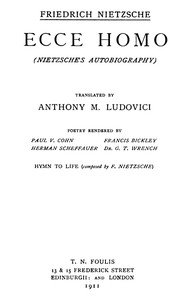
If you are looking for a free ecce homo pdf, you have found one of the strangest and most revealing books in all of philosophy. Written in 1888 and published in 1908, after Friedrich Nietzsche's death, Ecce Homo is the philosopher's autobiography, and it is like no autobiography ever written before or since. Instead of modestly recounting his life, Nietzsche reviews his own books, explains why he is a destiny, and tells the reader, in chapters with titles such as "Why I Am So Wise" and "Why I Write Such Good Books," exactly what he thinks of himself. The result is brilliant, funny, provocative, and sometimes unsettling, and it is the most personal book Nietzsche ever wrote. Because the book is in the public domain in the United States, you can download it legally and free in PDF and EPUB on Noveliopdf, with no account, no payment, and no trial to cancel.
Nietzsche wrote Ecce Homo in a burst of energy in the autumn of 1888, only weeks before the mental collapse in Turin in January 1889 that ended his working life. He knew he had written something extraordinary, and the book reads like a man taking stock of everything he had achieved and announcing himself to the world. Beneath the boasting, though, there is a serious purpose. Nietzsche believed that a thinker's ideas could only be understood through the life that produced them, and in Ecce Homo he gives readers the story of that life: his illnesses and how he learned to use them, his solitude, his tastes in food and climate, his hatred of German beer and Wagner's later music, and the long, lonely road that led to books like Thus Spoke Zarathustra and Beyond Good and Evil. For anyone who wants to understand Nietzsche in his own words, this free Ecce Homo pdf is the place to start.
What Ecce Homo Is About
Ecce Homo is built around Nietzsche's own works. After a short opening section about his life and his way of thinking, he devotes a chapter to each of his major books, explaining what each one meant and why it mattered. He calls Zarathustra his greatest gift to humanity, describes Beyond Good and Evil as a book of criticism and destruction, and treats his early works with a mixture of affection and severity. Readers who have already read some Nietzsche will find these chapters fascinating, because they show how the philosopher himself wanted his books to be read. Readers who are new to Nietzsche will find them a useful map of his whole career, a guided tour through a body of work that can otherwise feel forbidding.
The book is also famous for its smaller, stranger passages. Nietzsche writes at length about his health, explaining that his long illnesses taught him to think clearly and to value the small things that keep a mind working: dry air, long walks, the right food, and freedom from noise and other people's demands. He writes about the places that shaped him, the books he loved and hated, and the people he admired, including the French moralists and the ancient Greeks. He even gives advice on how to read him, warning readers not to take him literally where he is being playful and not to miss the jokes. This mix of grand philosophy and everyday detail is what makes Ecce Homo so readable. It is not a dry treatise; it is a performance, and Nietzsche is enjoying every minute of it.
"How One Becomes What One Is" — The Subtitle That Explains the Book
The subtitle of Ecce Homo is "How One Becomes What One Is," and it holds the key to the whole book. For Nietzsche, a person's task in life is not to imitate others or to follow rules handed down by religion and tradition, but to become the person they already are underneath everything they have been taught. This idea, which he called self-overcoming, runs through all his mature work. In Thus Spoke Zarathustra, the prophet Zarathustra teaches that human beings must overcome themselves; in Ecce Homo, Nietzsche shows how he tried to do it himself, turning his suffering into strength and his loneliness into freedom.
That is why the book's boasting is not empty vanity. When Nietzsche calls himself a destiny, he means that his ideas are meant to change the way people think about morality, religion, and truth, and he is announcing that change himself rather than waiting for history to do it. Modern readers may find the tone shocking, and they should. Nietzsche wanted to shock. He believed that polite philosophy had become a way of avoiding hard questions, and he wrote Ecce Homo as a deliberate provocation, a book that forces readers to decide whether they are ready to think for themselves. Downloading the free Ecce Homo pdf and reading the subtitle chapter by chapter is one of the best ways to grasp what Nietzsche meant by becoming who you are.
Why Read Ecce Homo
Ecce Homo is the best introduction to Nietzsche's own view of his work, and it is also one of his shortest and most entertaining books. Unlike his longer, denser works, it can be read in a few sittings, and its short chapters make it easy to dip into. It is also the book that humanises a philosopher who is often treated as a frightening figure. Here Nietzsche is witty, vain, wounded, and wonderfully alive, a man who loved good food and mountain air and who wrote some of the most beautiful sentences in German while suffering from terrible headaches. Readers who have been curious about Nietzsche but put off by his reputation will find this book a friendlier door into his thought than his more systematic works.
The book is also essential for students and serious readers of philosophy. Because Nietzsche reviews his own books here, Ecce Homo is quoted constantly in scholarship on his work, and understanding it makes everything else he wrote easier to read. It explains his break with Wagner, his quarrel with Christianity, and his belief that the highest human achievement is to affirm life exactly as it is, with all its suffering. Whether you are studying philosophy, reading Nietzsche for the first time, or returning to him after years away, this free PDF EPUB download gives you the philosopher's own account of his life and work, complete and unabridged, in a format you can carry anywhere.
About Friedrich Nietzsche
Friedrich Nietzsche was born in 1844 in Röcken, Prussia, the son of a Lutheran pastor. A brilliant student, he became a professor of classical philology at the University of Basel at the age of twenty-four, but poor health forced him to resign, and he spent the rest of his working life moving between Switzerland, Italy, and France, writing in solitude. His major works include Thus Spoke Zarathustra, Beyond Good and Evil, and The Antichrist, and his ideas about the death of God, the will to power, and the Übermensch have shaped modern philosophy, literature, and psychology. He collapsed in Turin in January 1889, never recovered his mind, and died in 1900. Ecce Homo, written just before that collapse, is his final statement about himself, and it has been read and argued over ever since.
How to Download Ecce Homo Free in PDF and EPUB on Noveliopdf
Downloading your free Ecce Homo pdf on Noveliopdf takes less than a minute. Open the book page for Ecce Homo, choose the PDF or EPUB button, and the file downloads straight to your device while the website stays open, so you can keep browsing for your next read. The PDF is ideal for reading on a computer or tablet and for printing, while the EPUB works beautifully on phones, e-readers, and reading apps, with adjustable text size and bookmarks. Both files are the complete, unabridged book, in the public domain in the United States, so the download is completely legal and completely free. There is no account to create and nothing to pay. If you enjoy this one, try Thus Spoke Zarathustra for Nietzsche's great poetic masterpiece, or Beyond Good and Evil for his sharpest attack on traditional morality, both free in PDF and EPUB on Noveliopdf.